



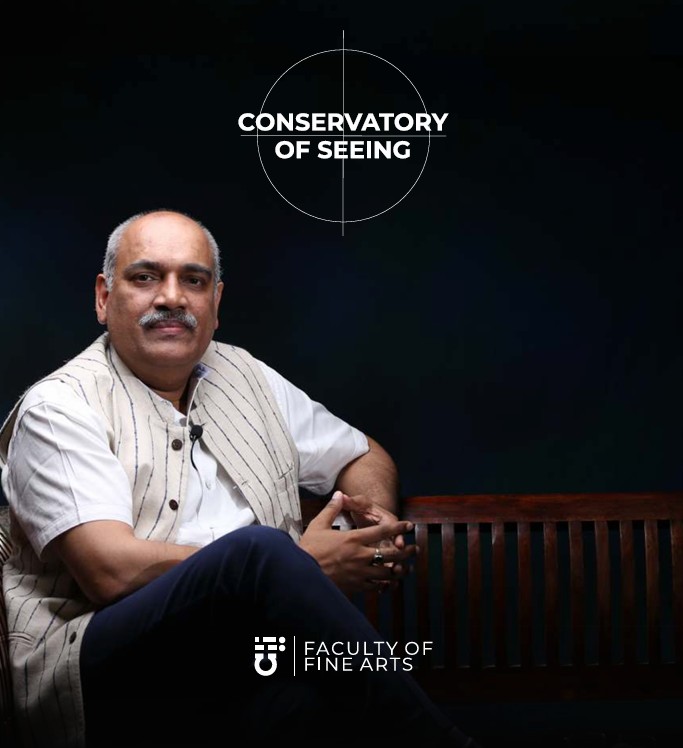
By Rajesh Goyal
Founder Director, Indian Institute of Photography | Founder Trustee, IIP Foundation
There are certain decisions in life that are not taken in one moment. They are built slowly through experience, observation, pain, passion and responsibility. For me, the Indian Institute of Photography was not just an institute that had to be made. It was a responsibility that had to be fulfilled.
I came from the world of art, photography, advertising and visual communication. As a student of the College of Art, Chandigarh, photography was not just a subject for me. It was a way of seeing life. While I was still studying, I had already started working professionally, taking assignments, understanding clients, creating images, observing people and learning how powerful a photograph can be. I later stood first in Punjab University in my batch, but even then, marks and recognition were not the real achievement. The real achievement was that I had understood the power of visual language.
Photography is not only about a camera. It is about observation. It is about patience. It is about discipline. It is about timing. It is about emotion, light, composition, storytelling and truth. A good photographer does not only capture what is visible; he or she reveals what is meaningful.
During my years in advertising, branding and visual communication, I worked on hundreds of campaigns and many brands. I saw how one strong image could change the way people think, buy, remember and connect. I saw how photography was needed everywhere: advertising, media, journalism, fashion, food, product, travel, tourism, education, culture, government campaigns, corporate communication and social causes. Yet, despite such a huge need, photography education in India was not available to everyone in a structured and serious manner.
In India, there were lakhs of young people with a camera in hand and passion in their heart, but no clear direction. Some were hobbyists. Some were students. Some were working professionals looking for a stress buster. Some were creative people wanting to convert passion into profession. Some were parents who wanted their children to explore creativity. Some were from small towns and villages, where access to professional institutes was almost impossible. Some were Indians living abroad who wanted to learn photography in a simple, structured and Indian way.
The question in my mind was simple: why should photography learning be limited to a few people in big cities?
If cricket could become a national dream, why could photography not become a national creative opportunity?
Cricket became big in India because it moved from elite grounds to streets, schools, colonies, stadiums, academies, television and homes. Every child could imagine holding a bat. Every family could understand the dream. Every small-town talent could believe that one day, he or she could play for the country.
I wanted photography to have the same democratic spirit.
I wanted a young student in Bareilly, Guwahati, Patna, Jaipur, Kargil, Ahmedabad, Kolkata, Dubai, London, Singapore or New York to feel that photography learning is possible. I wanted a homemaker to feel that photography can become a meaningful passion. I wanted a working professional to use photography as a stress buster. I wanted a teenager to use photography to become more observant and expressive. I wanted a serious learner to build a career. I wanted a creative Indian to believe that the camera can become a tool of dignity, livelihood and contribution.
That is how the idea of the Indian Institute of Photography started taking shape.
In 2010, when online education was not the phenomenon it is today, I envisioned online photography learning as a way to make quality education accessible to all. At that time, the idea was not easy. People would ask: how can photography be taught online? How can a practical art be learned through distance? How will students understand camera, light, framing and aesthetics?
My answer was clear: if the pedagogy is strong, if the content is structured, if assignments are practical, if mentoring is personal, and if feedback is honest, photography can be taught beyond the walls of a classroom.
We designed online photography courses not as casual video lessons, but as complete learning journeys. The purpose was not to give information. The purpose was to build the eye. Students had to learn camera functions, but more importantly, they had to learn seeing. They had to understand light, composition, subject, timing, story, visual balance, aesthetics and purpose. They had to practice, submit work, receive feedback, improve and build confidence.
This was the beginning of a movement.
Over time, the Indian Institute of Photography became a platform where online, regular, hybrid, short-term, weekend, diploma, bachelor’s and master’s level education could exist with one core philosophy: photography must be learned through practice, discipline, mentorship and real-world exposure.
For me, education was never about classrooms alone. A photographer cannot be made by lectures only. A photographer must go out, observe society, document people, understand culture, respect nature, study light, work with subjects, make mistakes and learn from them. That is why IIP Academy teaching pedagogy has always included assignments, critique, mentoring, workshops, live projects, study tours, exhibitions, juries, portfolio building and professional exposure.
At IIP Academy, students have learned inside studios, but also in streets, festivals, villages, heritage sites, galleries, institutions and live events. They have documented Kashi, Kumbh, Ladakh, Noida, artisans, weavers, food traditions, cultural festivals, social initiatives and national campaigns. They have participated in projects that gave them not only photographs, but understanding.
This is where photography becomes education.
A student who documents Kumbh does not only learn crowd photography. He learns faith, scale, discipline, patience and India’s civilisational continuity. A student who documents a weaver does not only learn portraiture. She learns labour, tradition, hand skill, dignity and economy. A student who photographs waste management does not only learn documentary technique. He learns environment, responsibility and citizenship. A student who photographs a mother, a craftsperson, a farmer, a ritual, a festival, a street or a landscape learns that India is not a concept. India is a living visual experience.
This is why IIP Foundation became important.
IIP Foundation, which stands for Initiatives for India’s Progress, was created with the belief that education must connect with society. If photography only creates professionals, it is useful. But if photography creates sensitive, skilled and responsible human beings, it becomes nation-building.
Through IIP Foundation, we worked on projects connected with education, environment, culture, women empowerment, livelihood, disaster relief, heritage documentation and community support. Initiatives such as Garbage to Garden, Feed the Needy, Adarsh Project, Bengal Project, Atmanirbhar Bharat livelihood support and Santosh Silai Kendra were not separate from our educational vision. They were part of the same belief: creativity must serve people.
When we supported families during Covid, when we helped women with sewing machines, when we supported Divyang persons with wheelchairs, when we distributed ration, blankets, sarees, livelihood material or created awareness around environment, the purpose was not charity for display. The purpose was dignity. If a woman receives a sewing machine and starts earning, that is not donation; that is empowerment. If a family receives food during crisis, that is not relief alone; that is humanity. If a student documents a social project, that is not only photography; that is sensitivity training.
This is my understanding of education.
In these years, IIP Academy has trained and certified more than 32,000 photographers from 44 countries through online and offline modes. More than 1,800 students have been educated through professional diploma, bachelor’s and master’s programs and are serving across the world in leading brands, agencies, media houses, production companies, corporates and independent creative practices. For me, every such student is a contribution to the creative economy of India.
Our students have worked with major brands and institutions. IIP Academy has also supported premier institutions and national bodies as a knowledge partner, including IITs, IIMs, BITS Pilani, Anna University, Zakir Husain College, the Office of the Hon’ble President of India, Parliament of India, DRDO and many more. Through workshops, expertise, scholarships and visual guidance, we have tried to make photography more respected, more structured and more meaningful.
This journey also brought awards and recognition, but awards were never the destination. The real recognition is when a student from a small town becomes financially independent. The real recognition is when a parent says their child has found direction. The real recognition is when a working professional says photography has reduced stress and added joy to life. The real recognition is when a student begins to see India with pride and responsibility.
Photography has the power to heal. It has the power to focus the mind. In a world full of pressure, speed and digital noise, photography teaches you to pause. It teaches you to look carefully. It teaches you to be present. For many people, photography may not become a profession, and that is perfectly fine. It can become a passion, a stress buster, a creative discipline, a way to travel better, a way to understand family, nature, culture and self.
This is why I always say that photography education should be for everyone.
Not everyone who plays cricket becomes a cricketer, but cricket builds fitness, joy, discipline and teamwork. Similarly, not everyone who learns photography must become a professional photographer. Photography can build observation, creativity, patience, confidence, communication and emotional balance. But for those who want to become professionals, it can become a powerful career. It can create entrepreneurs, artists, filmmakers, documentarians, educators, photojournalists, commercial photographers, fashion photographers, product photographers, travel photographers and visual storytellers.
My mission has always been to create this bridge: from passion to profession, from hobby to healing, from camera to career, from creativity to contribution.
Today, as we look at the future, I believe India is entering the age of creative leadership. The world needs content. The world needs stories. The world needs authentic visual culture. India has the youngest talent, deepest traditions, richest festivals, strongest craft heritage and most diverse human stories. If we train our youth properly, India can become a global visual knowledge hub.
The vision of IIP Institute for Cultural and Creative Arts is born from this belief. Photography, filmmaking, painting, design, research, Indian knowledge systems, cultural documentation and creative entrepreneurship must come together. We need institutions that do not only teach software or camera settings, but also build thinkers, artists and leaders.
My dream is to see photography learning become as accessible as cricket coaching, as respected as any professional education, and as joyful as a lifelong passion. Whether someone is a school student, college learner, homemaker, traveller, working executive, retired professional, artist, entrepreneur or international learner, photography should be available as an opportunity.
When I started this journey, I was not thinking of building only an institute. I was thinking of passing on a legacy. I was thinking of making art accessible. I was thinking of giving confidence to creative people. I was thinking of documenting India. I was thinking of contributing to my country.
The Indian Institute of Photography is my offering to learners.
IIP Foundation is my offering to society.
And this complete journey is my contribution to India.
If through one camera, one student finds purpose, one family finds livelihood, one tradition gets documented, one community receives dignity, one young Indian gains confidence, and one story of Bharat reaches the world, then the vision has succeeded.
Photography gave me a way to see the world.
Through IIP Academy, I want to give that vision back to the world.